
Scottsdale Center for Plastic Surgery
5410 North Scottsdale Road A-500
Paradise Valley, AZ 85253
Phone: (480) 423-1973
Monday-Thursday: 8:30 a.m.–5:00 p.m.
Friday: 8:30 am–4:00 p.m.
Breast Implant Options

There are many different types of breast implants available for women considering breast augmentation. Women can choose between saline and silicone gel-filled implants. Additionally, there are different widths and projections available (low profile, low-plus profile, moderate profile, moderate-plus profile, high profile, extra-high profile). Below are answers to a few of the most common questions our plastic surgeons hear about breast implants from Scottsdale and Phoenix, AZ, breast augmentation patients.
Request a cosmetic consultation with Dr. Robert Cohen or Dr. Steven Sigalove to learn more about your options when choosing breast implants. Our facility is conveniently located for patients living in Tempe, Paradise Valley and other areas of Greater Phoenix.
Should I choose saline or silicone implants?
Silicone implants have been available continuously since they were invented in the 1960s; however, their use was limited in the early 1990s due to fears that they caused autoimmune diseases. At that time, there was minimal data to prove or disprove these claims. As a result, a vast number of scientific studies were performed to answer the question: “Do silicone implants increase the risk of autoimmune diseases or breast cancer?” The answer is no, silicone implants do not increase the risk of contracting these diseases.
Although it took the legal system and the FDA many years to catch up to science, silicone implants are now available to women having a first time breast augmentation.
Interestingly, silicone implants were never completely off the U.S. market. Across the U.S., including Phoenix and Scottsdale, silicone breast implants have always been available to women interested in breast augmentation if they needed an augmentation and breast lift at the same time, or if they needed breast reconstruction, or revision of a saline implant breast augmentation due to excess wrinkling of the skin or multiple deflations. You would think that if the implants were truly dangerous, nobody would have had access to them. Clearly, silicone implants do not, and never did, pose a risk of autoimmune disease or breast cancer.

The decision to use silicone or saline implants is a personal one, but the decision should not be based a fear of silicone. The newest generation silicone implants are made of “cohesive silicone gel,” which is not liquid silicone. Modern cohesive silicone gel implants are solid, like a soft gummy bear, and if they are cut in half the gel holds its shape and does not leak out.
Compared to saline implants, these cohesive silicone gel implants feel more like natural breast tissue, are less likely to produce visible rippling or wrinkling, and do not “deflate” like a saline implant if wear and tear produces a small hole in the outer covering of the implant over time.
In both Dr. Cohen and Dr. Sigalove’s opinion, cohesive silicone gel implants are a superior breast implant material. If asked by a friend or family member whether our surgeons would recommend saline or silicone, they would strongly recommend silicone for the best, most natural result
Motiva® implants
Recently approved for use in the U.S. by the FDA, Motiva implants have been utilized for breast enhancement surgery internationally. They have been thoroughly tested and found to be safe, designed to reduce the risk of complications while achieving a natural look and feel.
Designed with safety in mind, Motiva implants use special technology to ensure the implants work with your body to look and feel natural while minimizing the risks often associated with breast implants.
Motiva implants use an innovative surface technology, called SmoothSilk®, which functions to improve the body’s response to your implants, helping the tissue around the implants stay soft and minimizing the risk of capsular contracture. Inside, Motiva implants use ProgressiveGel PLUS®, and advanced silicone gel formula designed to move and feel like natural breast tissue to give you the curves and fullness with a natural feel.
What are the two types of Motiva implants?
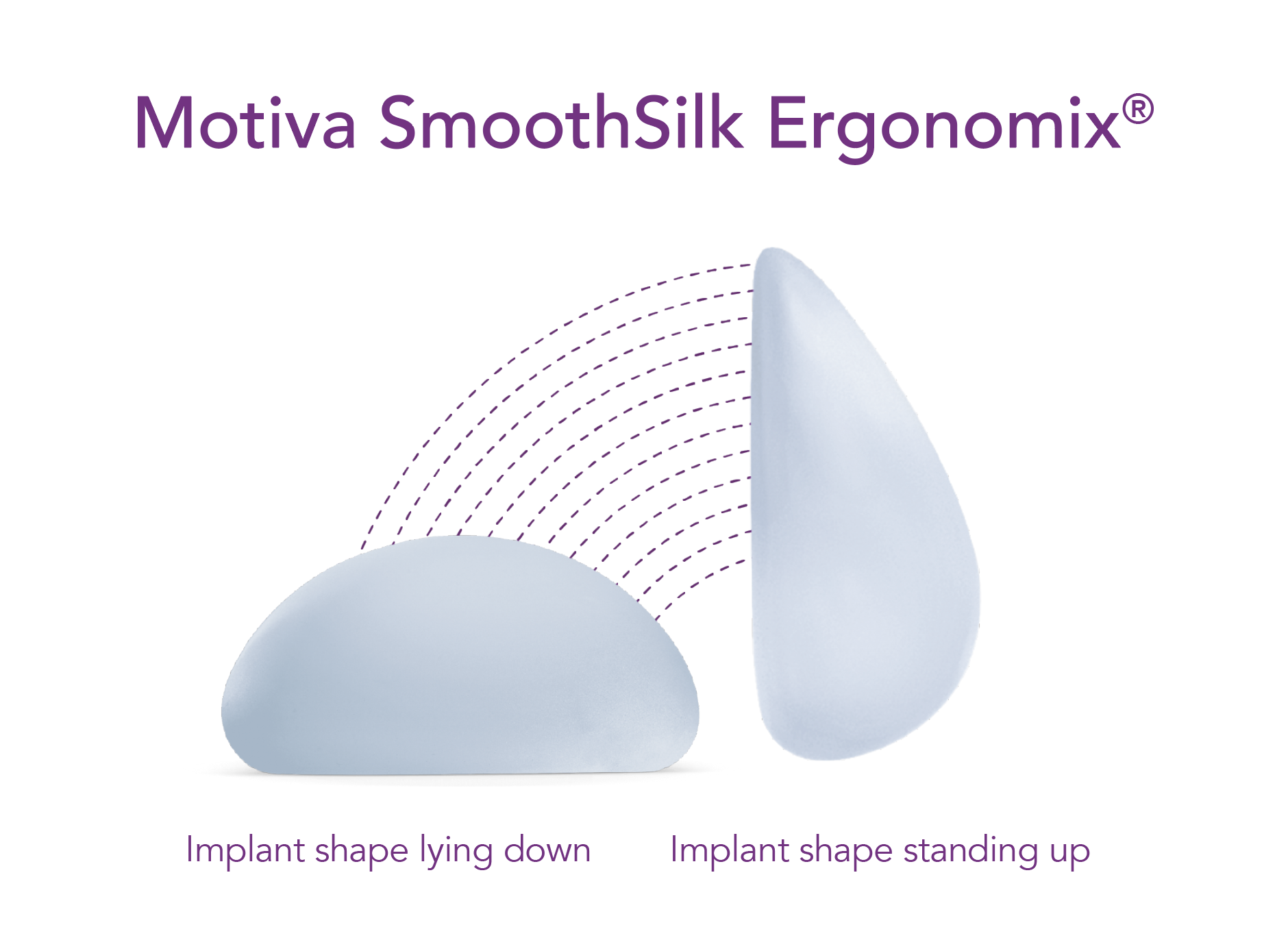
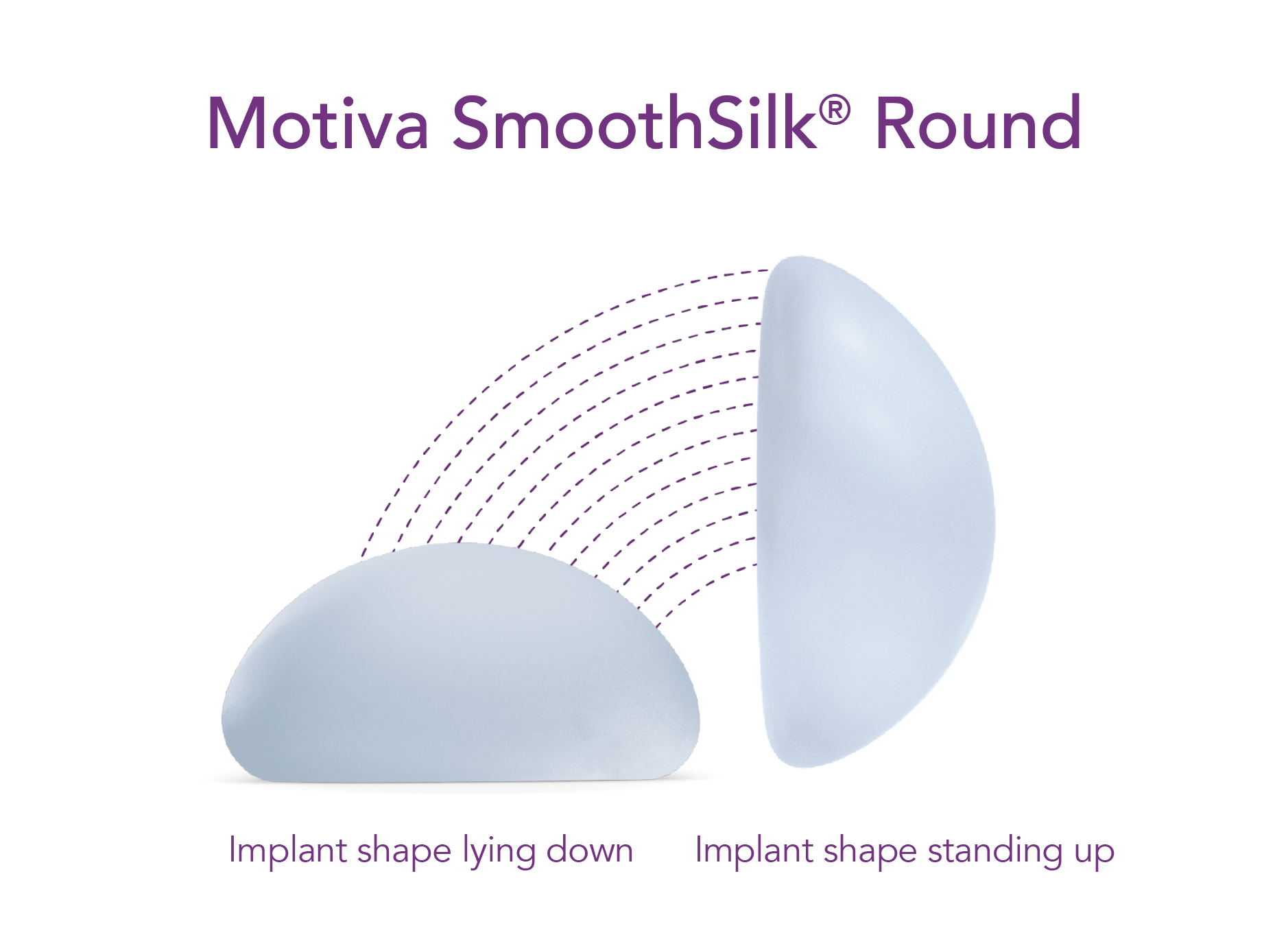
Motiva implants are available in 2 shapes, Motiva SmoothSilk Ergonomix® and Motiva SmoothSilk® Round breast implants.
Motiva SmoothSilk Ergonomix implants are designed to realistically mimic the look, feel, and movement of natural breasts. They adjust with your body’s position, forming a round shape when you lie down and a teardrop shape when you stand up.
Motiva SmoothSilk Round implants are designed to create upper pole fullness and have a soft, natural feel. They maintain their round shape whether you are standing up or lying down.
We are excited to offer the latest breast implant technology to ensure patient safety and satisfaction. Contact us at (480) 423-1973 or request a consultation with Dr. Sigalove to learn if Motiva implants are right for you.
What is a breast implant profile?
The “profile” of an implant refers to the width and projection of an implant. In other words, for a given implant volume:
- Low profile is wider and flatter (projects less)
- Moderate and moderate-plus profiles are in between
- Extra or ultra high-profile is a narrower, more projected version
Profile types vary between brands and have different parameters for each profile. For example, a moderate round silicone Sientra implant has a similar projection to a moderate-plus silicone Mentor implant.
How do I decide which implants to get?
Implant size and profile should always be considered individually for each patient. The decision should be based on the patient’s chest diameter, the width of the patient’s breasts, skin elasticity, ribcage asymmetry, and her goal size, among other factors. For each patient, there is a range of implants that will look natural. If too wide or too narrow an implant is used, or if too large or too small an implant is used, an unnatural result can occur.
Our goal as experienced board-certified plastic surgeons is to provide professional guidance to women considering breast augmentation. The objective is always to produce a natural and aesthetic final result, and within this range, some patients prefer to remain relatively small-breasted, while others prefer to be larger-breasted.
In most patients with an average chest width, we find that as they get into larger size ranges, we are more inclined to use a somewhat higher profile implant, while in lower sizes, we use a more moderate or lower profile implant to create a better base width diameter match. Obviously, this is adjusted for every patient to create the best final result.
Ready to
Learn More?
Request Your Consultation How can I be sure I will look natural after surgery?
Before our surgeons enter the operating room, they always have a plan regarding which implants will likely be selected for each patient. These are chosen using a combination of preoperative chest measurements, photos from the website selected by the patient, and the use of preoperative sizers tried in a special bra. Sometimes, patients require a different size or profile implant on each side if they have pre-existing asymmetry. The implants our surgeons think they will use are the starting point, but because they have their own operating room with a full consignment of multiple implant brands, shapes and sizes, our surgeons can choose the final implants based on what looks best during surgery.
With most breast augmentations we perform at the Scottsdale Center for Plastic Surgery, we use implant “sizers” during surgery. These are different from the sizers we use in during the pre-operative exam.
The surgical “sizers” are temporary replica implants that let the plastic surgeon see exactly what the final implants will look like. The preoperative plan regarding a specific implant size and shape is usually correct. However, by using the sizers and checking our patients from multiple positions and angles, our surgeons maximize the ability to achieve the best size and symmetry possible.
Using intraoperative sizers adds a little extra operating time, and because of this, some surgeons skip this step. Our feeling is that patients will not remember if they were in the operating room for an extra few minutes, but they will be looking at the final results for the rest of their lives. We believe strongly that the extra time and effort spent to achieve the best shape and symmetry is well worth it.
Fat transfer vs breast implants
Fat transfer breast augmentation is a technique some of our patients from Scottsdale, Phoenix, and surrounding areas ask about. During the procedure, also called natural breast augmentation, we use liposuction to harvest your own surplus fat. We purify the fat and inject it into the breasts. It’s an alternative to breast implants for women who want to increase their breast size by only about 1 bra cup. You can read more about fat grafting versus breast implants in one of our recent blog posts.
Treatment
Designed specifically for our surgical patients, our VIP Skincare Program offers exclusive promotions to enhance your recovery. Get special rates for our most sought-after aesthetic treatments, expertly curated to minimize swelling, accelerate healing, and mitigate scarring. Take your recovery to the next level. Schedule your surgery today to take advantage of the VIP Skincare Program.
Request My ConsultationTake the Next Step
Request a cosmetic consultation or call (480) 423-1973 to schedule a consultation with Dr. Robert Cohen or Dr. Steven Sigalove. Your surgeon will be happy to answer any questions you may have about breast implants. Women in Arizona, as well as those coming from other states and countries, trust board-certified plastic surgeons Dr. Cohen and Dr. Sigalove, who offer surgery at their private facility conveniently located near Phoenix and Tempe.
Back to Top